Sunday, June 18, 2006

Anakao


The transfer to Anakao was unremarkable: we took the same tiny De Haviland plane that took us to Morondava and had a mysterious layover in the middle of nowhere (see pix) en route to Tulear (I suspect the pilot had to use the boys room). In lieu of a romantic cruise from Tulear to Anakao, we had a slight logistics change that made us take a Taxi-Brousse for half the way, followed by a tiny fishing boat that stopped at every fishing village on the way to our hotel... very exotic. Five hours after landing in Tulear, we finally disembarked at the Anakao Club Resort. A rare find, our hotel was the first bit of real luxury we experienced on the big Island. Nice. We did nothing but relax and went snorkeling/bird watching on Nosy Ve (a tiny Island off the coast - a 30 minute pirogue ride). Anakao Club Resort is a brand new property held by an Italian perfectionist from the Val D'Aoste. Although it was not mentioned in any of our guidebooks, we highly recommend it for its exceptional management and impeccable facilities (currently 6 bungalows).

On the road again


The ride back from the Tsingys was our first true bush adventure. We had been cruising along on the "road" for about an two hours when our right back wheel fell off (I mean this litterally). The drive shaft gears had fatigued to the point it broke off and fell out. After stepping out and assessing the damage under the scorching midday sun, our driver confidently estimated he would need an hour for the repair. I know nothing about bush mechanics but this sounded rather optimistic so we looked for a contingency plan. We hitched a ride with a group of swiss people from Zurich to the next town, a crammed 1-hour drive (8 people + luggage in a mid size SUV). While we were having lunch there our guide arrived in another vehicle (a Toyota land cruiser seating 10...). He announced that the repair hadn't gone as smoothly as expected, and proposed his "solution": joining the group of 10 people in the land cruiser (between 4 and 5 westerners per row of back seats) for the second half of the trip. I gladly refused this unattractive option, and once again used my newly developed Malagasy negociation technique which consits of repeatedly stating exactly what you want (in our case our own car) with complete disregard for the other party's argument. A crucial point of this technique is to carefully listen to your opponents explanation, making it clear that you understand his argument and by facial expression giving him the impression he convinced you of his position. At that point, when his hopes are high he won the argument and stops talking, you calmly repeat what you want, making for a disarmingly absurd discussion that will quickly discourage the person you are facing. Works every time... We got our own car, the drive back to Morondava was a (bumpy) breeze, and after a night in a Bungalow on the beach we took off for Tulear en route to Anakao.

Tsingy de Bemaraha - size matters


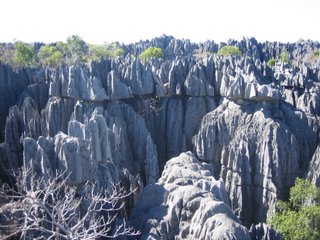
The Tsingys are a UNESCO world heritage site (the only one in Madagascar), attracting more and more visitors each year. To get there you need to brave 130 miles (200km) of "piste" a loosely defined dirt road. The drive from Morondava can take up to 10 hours, so it's rather rough on sensitive stomacs. There are also two river crossings (the "ferry" only takes you accross twice a day, so you better not miss it, as we found out...). There is only one really nice hotel at the entrance of the park called the "Relais des Tsingy". The bungalows are rustic, but have water and electricity for 4 hours a day (a huge luxury) and are in a beautiful setting on top of a hill. We stayed three nigths and visited both the Petits Tsingy and the Grand Tsingy. The extra day was probably not necessary, as the larger Grand Tsingy are pretty much a bigger, more impressive version of the Petits Tsingys. However, given the 10 hour drive, staying the extra day is probably the more reasonable thing to do. Update to our critter count: we saw the elusive jumping rat, another check in our book.

Kirindy


Maureen arrived on Friday and we took off the same day for Morondava. We flew in the smallest Air Madagascar plane so far, an ancient prop with 15 or so foldable seats, fixed landing gear and an analog radio. In Morondava we met up with Florence, a friend from college who had spent 7 month in Madland to work on a small tv broadcasting project. She gave us the quick tour of the town feeling somewhat nostalgic as it she was leaving the same day for home (via Tana by Taxi brousse). After lunch we took the road to Kirindy, a forest preserve 30 miles (50km) north of Morondava. When I say "road" I don't want to mislead you into thinking of something paved (hah!), or even remotely straight or even. It took us 2 hours to drive the 30 miles, so this should give you some indication of the shape of the road. On the way to Kirindy we passed through the "avenue of the Baobabs", you can't get enough of these strange trees. In Kirindy Maureen got her first glimpse at Malagasy accomodations, as well as a bunch of lemurs. We did a night tour and the day tour, saw some snakes, some chameleons, the local (tiny) version of a puma a bunch of nocturnal and diurnal lemurs as well as the relatively rare mouse lemur (as you would have guessed, it's a lemur the size of a mouse - the smallest primate on earth). Early start Saturday morning headed furhter north to the Tsingys.

Thursday, June 08, 2006

Got Lemurs


Yesterday we took a quick day trip to Andasibe, a rain forest located about 145km from Antananarivo (~3 hour drive). The big attraction of this park is its Indris, the largest lemurs of Madagascar. The forest in Andasibe is much denser and wetter than in Berenty and it felt much more like a jungle, complete with leeches and other bugs. We walked around in a slight rain for an hour before we spotted our first group. Indris are very impressive animals, moving around by making huge leaps from tree to tree. Most of the time they don't even land but merely bounce off one tree trunk to the other in game of giant pinball in the forest's canopy (I realize this probably only makes sense if you saw it). Here are a bunch of pictures. On our way back, we stopped at a private collection of critters (from French entomologist Peyrerasse - spelling might be off - its 80 km from tana) where we saw some amazing chameleons as well as more lemurs. The collection was worth the stop, and its no detour on your way back to Tana. Here is a video of a brown lemur eating a banana up close, and a chameleon medley, enjoy!

Tuesday, June 06, 2006

Baobabs: check - Lemurs: check


We spent the weekend at Fort-Dauphin, in the far south of the Island. The place itself is a dump. The very few decent buildings are occupied by QMM, a mining company subsidiary of Rio Tinto, and there are really no good accomodations (we stayed at top-of-the-line but decaying "Le Dauphin") and surprisingly prices are the same as in Tana. Locals blame inflation on the mining guys. But people come here for another reason: the town is located in a stunningly beautiful setting - a peninsula with opposing half moon beaches and mountains only miles away from the shores. Botany enthousiasts have access to all three types of primary forest (dry/transition/wet) within an hour drive. On Saturday Alvin and I visited Berenty, which is a small enclave of primary forest that was preserved in the middle of a gigantic agricultural complex growing some kind of Mexican Agave to be exported to China. Today I am pleased to say: mission accomplished. In fact, not only did I see Baobabs and Lemurs, but I even saw Lemurs on Baobabs! Because of its isolated nature, the animals in Berenty are trapped on a relatively small surface, and there are very easy to see. There are (lots) of Lemurs (ringtails, brown lemurs and the dancing sifaka), as well as boas, flying foxes (a 50-inch wingspan bat), and a bunch of colorful birds (sorry, no names, not really into that). Unfortunately, the boas were hibernating, so we only got to see a nest, and we were not allowed to get close to the godzilla bats. On the other hand, we saw a LOT of lemurs and these things are really fun to watch. One of the species (sifaka) can only walk upright... and sideways. Imagine white fluffy monkeys breakdancing to "walk like an egyptian", very entertaining. Here is a video of a ringtail feasting off a cactus.
Travelling tip: if you want to get an overdose of lemurs you should stay at the Berenty hotel, a bunch of bungalows right in the park. This is the lemur-watching equivalent of Pier 39. Don't spend more than one nigt though, as the reserve is rather small. Berenty is only 88km (55miles) from Fort Dauphin, but it takes 3 hours to get there because the road is in such a bad shape.

Tuesday, May 30, 2006

Getting Around in Antananarivo


To get around in Tana people use Taxis which typically are (really) ancient tan-colored Citroens 2CV or Renault "quatrelles". I have learned a thing or two about cars riding along in these venerable vehicles. For instance, there is a simple procedure to follow when you run out of gas trying to get up a hill: you take out the emergency plastic bottle filled with gasoline (the one you always keep safely tucked between the two front seats), pour some of it into the tank, open the hood, take a sip out of the bottle (yes, the one with the gasoline), detach some tubing from your engine, spit the gas into it and see the engine come alive again. It works every time, and its clinically proven to fight germs causing bad breath and the gum disease gingivitis.
Maybe I need to explain why running out of gas is such a frequent occurence. Gas is very expensive in Madagascar ($4/gallon). To put matters into perspective $4 is a full meal at a very fancy restaurant, or 40 loaves of bread. Imagine an $80/gallon world to give you a sense of what it would be like (if you have trouble using your imagination, just move to California and wait for a couple more years). This means that cabs only carry the absolute minimum amount of fuel (or less) and use a peculiar driving style, shutting off the engine any time the car has sufficient momentum or when gravity supports forward progress. For our geeky readers: image some type of pulse-width-modulated engine control scheme. This allowed us to see many innovative ignition switch variations, from the traditional (but sooo conventional) key to self-wired push button devices, to bare bone hotwiring. The latter is kind of tricky given the extensive sparking, especially if you just rinsed your mouth with 87 octane stuff.
PS: No meters in these things (are you kidding?). Note to future travellers, at the time of my writing rides within Tana are 3000ARY and 6000ARY to the outskirts. As a white boy, you will be quoted twice that amount, but we now consistently haggle it down to these numbers.

Monday, May 29, 2006

An Island off the island - Nosy Sakatia


I wanted to explore more of the region, so I hitched a ride on some guy's speedboat to a small island visible from our hotel. I decided to bushwhack my way up the hill, and by a stroke of luck found a trail after a little while. The trail connected microscopic little villages (2-5 huts each) lost in the middle of a really dense jungle. On the way up the hill, the landscape would constantly switch from a lush forest to lunar desolation (laterite erosion, I think). Check out the pix of the malagasy emblem (fan palm), and some weird jackfruit-type trees.

Out of Tana - Nosy Be


We left Tana to spend the weekend in Nosy Be, one of the hundreds of little tropical paradises you will find all over Madagascar. Nosy Be is an island off the northwestern coast, a short 1-hour flight away from bustling Antananarivo. We stayed at "Auberge Orangea" basically a few bungalows right on the beach. This is a very typical accomodation for tourists in the area, as pretty much the entire shore is owned by one of these small independent family operations, the owners of which are mostly foreign. Amenities are really basic, but prices are almost european (5Euro breakfast, the equivalent of a 3-course meal in Tana). We were just happy to get out of the Tana-scent (a delicate mix of gasoline and diesel fumes with powerful sewage accents) for a couple of days.
After swimming in the Mozambique channel, Alvin and I went for an exploratory walk in the area. Alvin wanted to blend in with the locals, so he decided to go barefoot neglecting the fact that he did not benefit from the thousands of years of genetic selection and grueling practice that keeps a smile on the face of local schoolgirls when they walk around barefoot on viciously sharp gravel roads heated by the scorching sun to the point you can fry an egg on them. Anyway, this was an opportunity to try ourselves at some local handicraft: download craft tutorial here (this one is worth it). I had a good laugh (notice I was the one wearing Tevas) and we also made some furry friends along the way. Good times...

Wednesday, May 24, 2006

Madagascar Part 2 - How I Learned to Stop Worrying and Love CIPRO


After a couple of rough days I am back on my feet exploring Tana. We went to see the market (check out Alvin's coverage of a local riot) and marveled at the tasty delights only a local farmers market can bring, such as fly infested chicken intestins and mold-cured fish remains. This outing made us hungry, so we went to an indonesian restaurant for dinner.
I also saw my first lemur. I must say these things are really cute. They don't look like monkeys at all, more like a genetic screw up between a squirrel, a panda bear and a chimp. They are very loud and a lot of fun to watch.
We are flying to Nosy-Be this weekend to scientifically investigate whether the Malagasy beaches are truly up to their reputation. Hard work, but I feel we will be up to the task. Breaking news: I was able to upload a few pix so check it out.